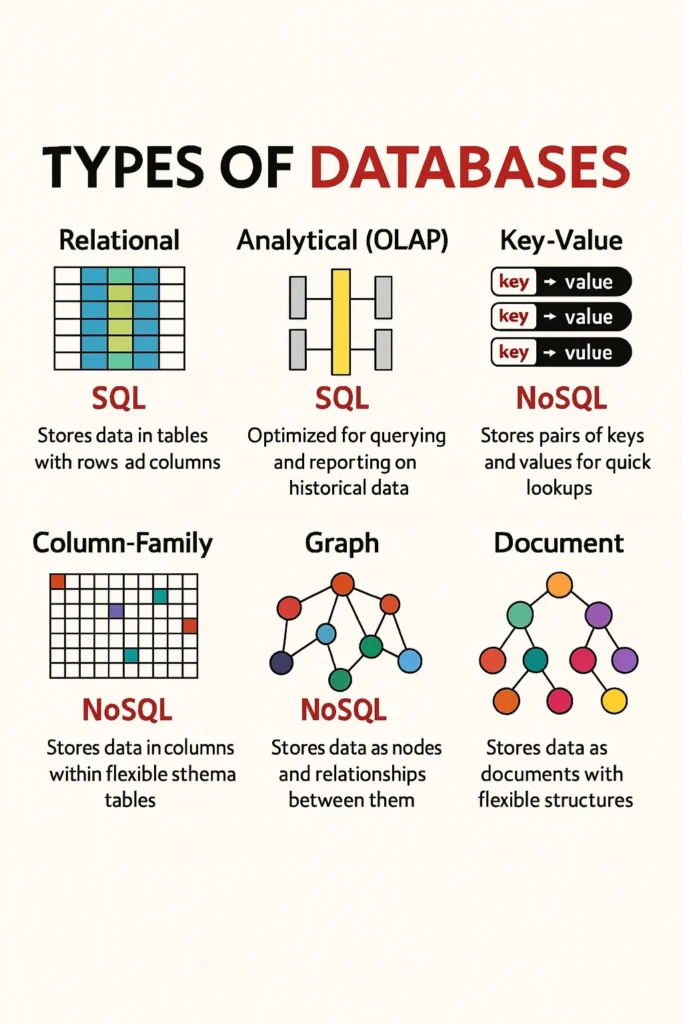
Databases are at the heart of every modern application. From storing user information to analyzing big data, choosing the right type of database can have a huge impact on performance, scalability, and overall system design. Broadly, databases are categorized into SQL (Structured Query Language) and NoSQL (Not Only SQL) systems, each designed for different use cases.
1. Relational Databases (SQL)
Relational databases store data in structured tables with rows and columns. They are ideal when data integrity, relationships, and complex queries are required.
Examples: Microsoft SQL Server, Oracle, MySQL, PostgreSQL.
2. Analytical Databases (OLAP – SQL)
Optimized for querying and analyzing historical data. These databases are essential for reporting, BI (Business Intelligence), and data warehousing.
Examples: Amazon Redshift, Snowflake, Google BigQuery.
3. Key-Value Databases (NoSQL)
Data is stored as key-value pairs, making lookups extremely fast. They are widely used in caching, session management, and real-time applications.
Examples: Redis, Amazon DynamoDB.
4. Column-Family Databases (NoSQL)
Instead of storing data in traditional rows, they use columns grouped into families. This allows flexible schema design and is perfect for high-volume data.
Examples: Apache Cassandra, HBase.
5. Graph Databases (NoSQL)
Designed to store and navigate relationships. Data is stored as nodes and edges, making them the best choice for social networks, recommendation engines, and fraud detection.
Examples: Neo4j, Amazon Neptune.
6. Document Databases (NoSQL)
Store data as documents (usually in JSON or XML format) with flexible schema. Perfect for modern web and mobile applications that need agility.
Examples: MongoDB, CouchDB.
Choosing the Right Database
- Use Relational SQL when your data has strong relationships and consistency is critical.
- Use NoSQL when scalability, flexibility, and handling unstructured or semi-structured data are top priorities.
At Codefine, we help businesses design and optimize their ERP and enterprise systems by selecting the right database strategy, ensuring performance, scalability, and cost efficiency.